
For decades, employers have focused on what benefits they offer. Increasingly, the competitive advantage lies in something else; whether employees can actually access, understand, and use those benefits when they need them. That’s becoming harder.
Healthcare costs continue to rise. Employees are demanding more personalized support. HR teams are being asked to move faster, operate more efficiently, and embrace AI, often without adding headcount. At the same time, employees have less patience for confusing enrollment experiences, fragmented systems, or benefits that are difficult to navigate.
The implications are significant. A great benefits strategy is no longer defined solely by plan design or employer investment. It’s defined by the experience surrounding those benefits: how easily employees can make decisions, get answers, resolve issues, and receive support throughout the year. That’s why the future of benefits isn’t about offering more, but about delivering better.
Our team created The Future of Employee Benefits trends report to explore how leading organizations are responding to this shift, and why AI, automation, and modern administration models are becoming essential components of the benefits experience.
Explore the full report here — or keep reading for the highlights.
Rising costs, lower tolerance
Unsurprisingly, healthcare costs remain the most visible pressure point. Last year average employer-sponsored family premiums reached an astounding $26,993, up six percent from 2024. The jump in 2026 is expected to be even greater — the highest in 15 years.
When costs climb, every benefits decision carries more weight. Employees have less room for error when choosing plans, estimating healthcare expenses, or deciding how to use programs available to them. The implication for HR leaders is clear: accuracy, clarity, and decision support are no longer “nice-to-haves.” They are cost-management strategies. Employees who better understand and use their benefits are better positioned to maximize the value of every dollar spent.
Guidance grounded in real utilization patterns, year-round communication instead of seasonal reminders, and seamless enrollment experiences are becoming foundational. But is that level of demand even possible for legacy benefits admin systems today? Not exactly.
Financial support is running the benefits conversation
For a time, addressing mental and physical well-being was employers’ top priority. But as the atmosphere has changed in the United States, so has the urgency for financial support. Sixty-eight percent of employees cite economic uncertainty as a major stressor. Only forty-seven percent feel financially well. Demand for emergency savings tools, debt support, student loan assistance, and clearer retirement education has never been louder.
For many HR leaders, the disconnect is familiar and frustrating: the financial support and benefits are there, but utilization is low. This gap almost always reflects an access issue.
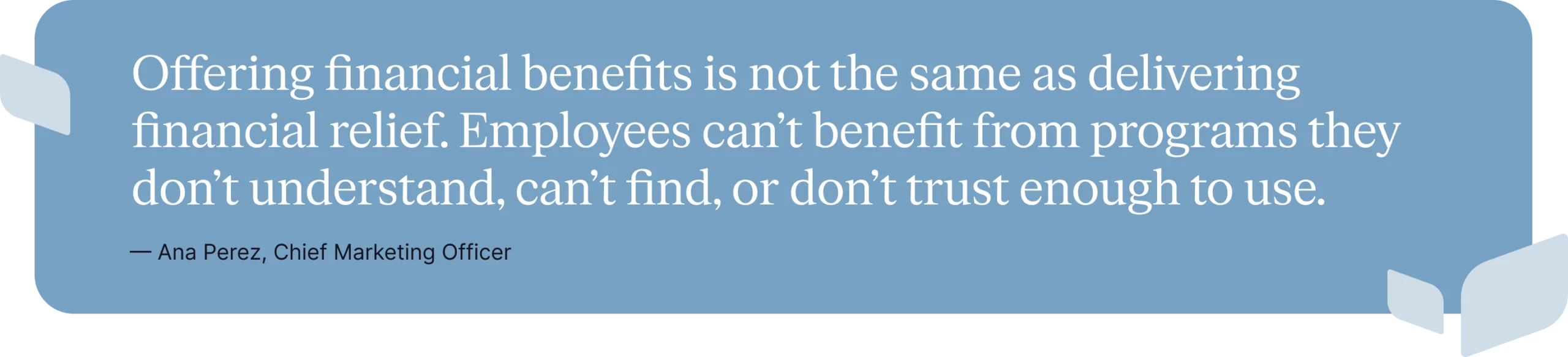
Offering financial benefits is not the same as delivering financial relief. Employees can’t benefit from programs they don’t understand, can’t find, or don’t trust enough to use. In 2026, financial wellbeing will be measured less by availability and more by utilization — and utilization depends on a seamless, intuitive experience.
The redefining of work-life balance
One of the more telling indicators in 2026 is that for the first time in 22 years, work-life balance edged out pay as the top priority when evaluating employers.
Sustainability is in. Predictable schedules, meaningful leave, and flexibility that functions consistently across teams are table stakes. Flexibility is no longer a perk layered on top of work — it’s infrastructure.
Policies must be executable, clearly communicated, and system-supported, and never dependent on individual interpretation. The connection between benefits, leave management, payroll, and scheduling systems plays a larger role than ever in determining whether flexibility feels real or rhetorical.
Trust as an operational outcome
Across a number of other trends, trust emerged as a throughline. Employees are more likely to trust their employer than many other institutions, and in high-trust environments, engagement and overall health indicators rise significantly. But what does that look like?
Most HR leaders have tussled with document verification, lapses in accuracy, missed payroll changes, and errors that keep you up at night. The systems that are trusted as the gateway to these programs are even more confusing. And today, with AI humming in the background as an efficiency and accuracy multiplier, the tolerance is lower for these errors, misunderstandings, and guesswork. It appears in attrition, satisfaction, and how employees show up at work.
Employees don’t decide whether they trust their employer based on a benefits brochure. Trust is earned during moments that matter: enrolling a dependent after a life event, receiving an accurate paycheck, getting a timely answer to a claims question, or making a confident enrollment decision. These are the experiences that shape whether benefits feel valuable or frustrating.
When these systems are smooth, fast, and error-free, trust is earned. When they’re not, it’s a gamble.
AI moves from concept to infrastructure
AI is still a defining piece of 2026 and 2027, but the question has changed. It’s no longer “What can this do?” It’s “Where is this embedded, and is it actually making us better?”
For HR leaders, that means two things. First, building AI into the foundation — training teams, upskilling thoughtfully, and weaving it into everyday workflows instead of treating it like a side experiment. Second, choosing partners who are already ahead of the curve.
In benefits administration, that difference is tangible.
- Smarter configurations pulled directly from source documents.
- Anomalies flagged before they ever reach a carrier.
- Decision support based on real utilization patterns.
But most importantly: in high-stakes moments, employees don’t want automation alone. They want trustworthy resolution, and that doesn’t exist in a world without humans. It’s AI-forward, but human-first: eliminating repetitive work so experts can focus their judgment where it matters. It’s service teams strengthened by AI-driven support, never replaced by it.
The standard for experience is rising
Much of the research in this report deserves consideration, but when you zoom out: nearly forty-two percent (42%) of employees spend fewer than 20 minutes reviewing benefits information, and only thirty-six percent (36%) feel extremely knowledgeable about their choices. Enrollment has become a high-stakes moment compressed into a short window of attention.
The expectation in 2026 is not more benefits, but clearer guidance. Fewer decisions per screen. Plain-language explanations. Systems that surface what matters and hide what does not. More digestible forms of content. The organizations best positioned for the years ahead won’t necessarily be the ones offering the most benefits, but the ones helping employees get the most value from the benefits they already provide.
That requires connected systems, embedded intelligence, year-round guidance, and human expertise where it matters most. Benefits administration is no longer a back-office function. It’s one of the primary ways employees experience their employer.
The finish line is not enrollment. Now, the real opportunity begins by helping employees understand, access, and use their benefits throughout the year. That’s how outcomes improve, costs are controlled, and trust is earned.
To explore these shifts in more detail, download The Future of Employee Benefits report.