Most major organizations and industry conferences this year have been, in some form, a conversation about AI. What will it automate, what will it replace, what will it swallow whole? These questions have been lingering for some time, and answers have started to emerge — and while we brought those conversations to PlanSource Eclipse 2026, our annual customer and partner event is built on a slightly different premise: AI-forward, but human-first.
Yes, the technology is moving fast, and PlanSource is using it to deliver innovation rapidly. But nothing meaningful happens in benefits administration without close collaboration across the ecosystem: customers, partners, brokers, carriers, and all the teams who deliver benefits to employees every day. That’s what makes Eclipse so impactful. It’s the place where we listen, iterate, and prototype with the people who not only live this work, but also help us define what comes next.
Over two days, that collaboration produced a clear through line. Paired with the judgment, care, and expertise of the people who make benefits work, AI becomes a force multiplier that de-risks the most error-prone parts of benefits administration, sharpens decision-making, and frees teams to focus on the people they serve. The result is what unlocks the new standard PlanSource is setting for the industry.
The need for a new standard in benefits administration
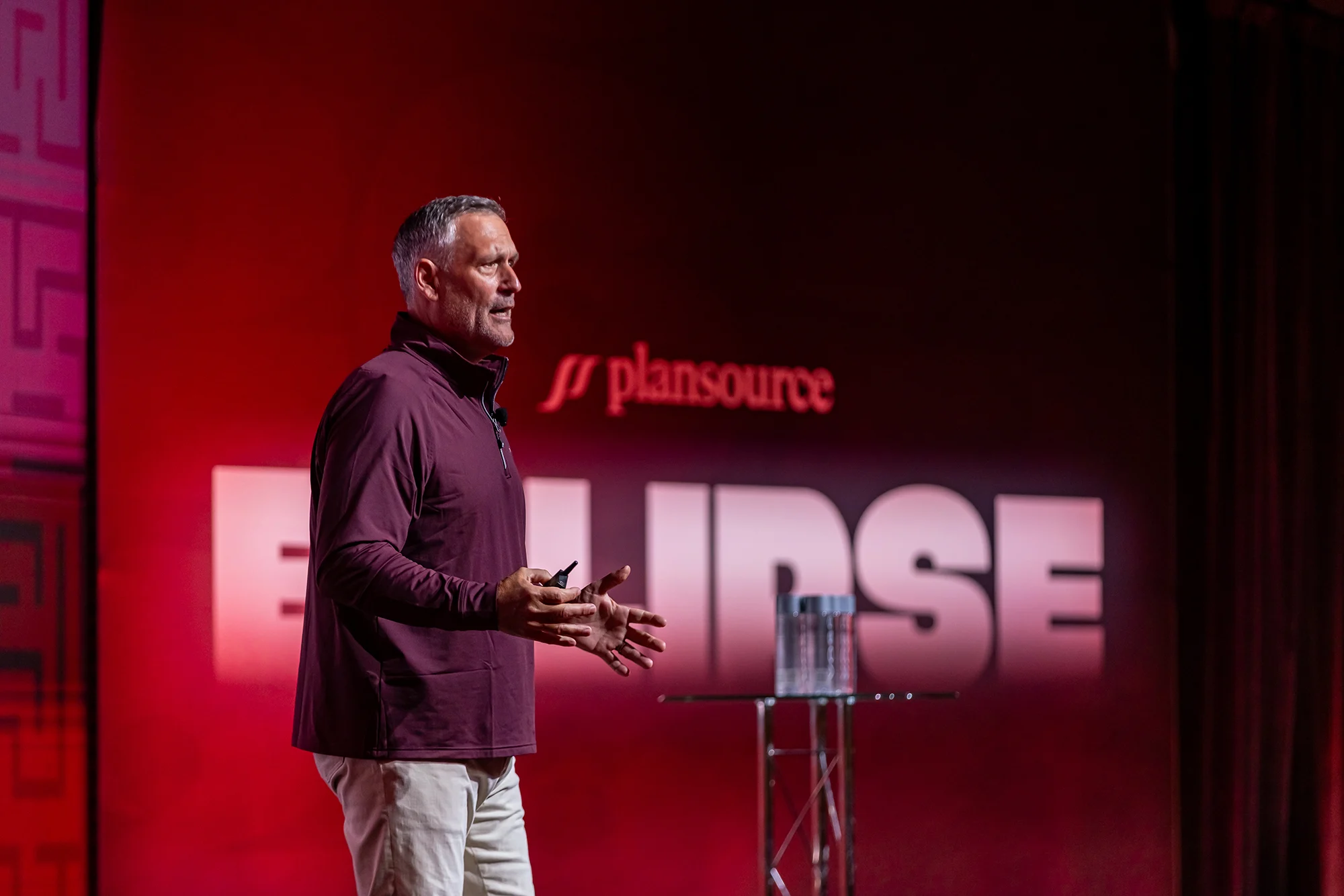
Before talking about where the industry is going, the morning keynote backed up to ask why a new standard is needed at all. Mike Morini, CEO, opened by naming the thing the industry has known for years: benefits administration is harder than it has to be. “It’s complicated, it’s fragmented, and no matter where you sit in the ecosystem, it’s just too difficult,” he said. The problem, he was quick to clarify, has nothing to do with effort. HR leaders work hard. Brokers and consultants work hard. The issue, in his words, is “a failure of design.”
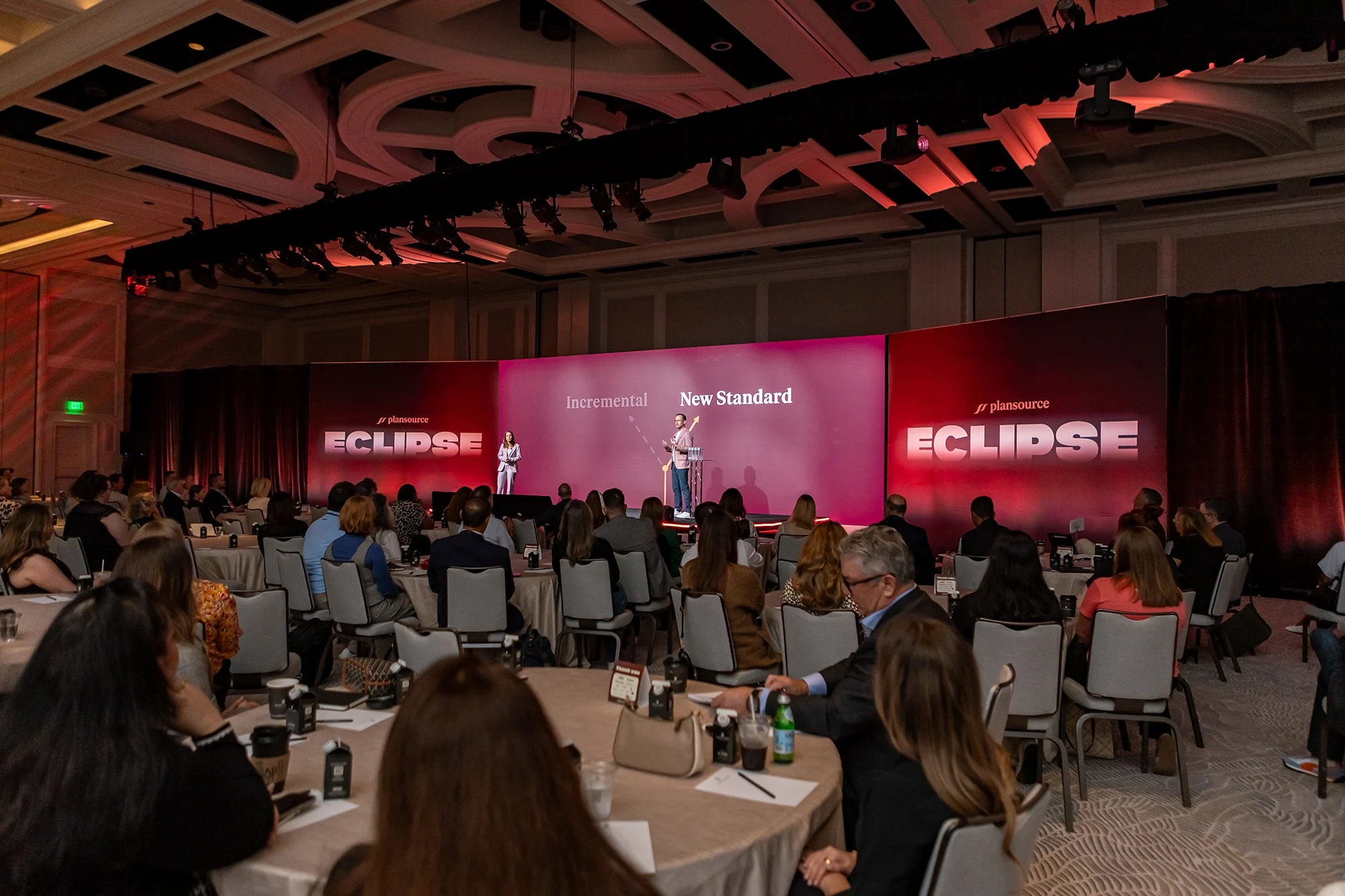
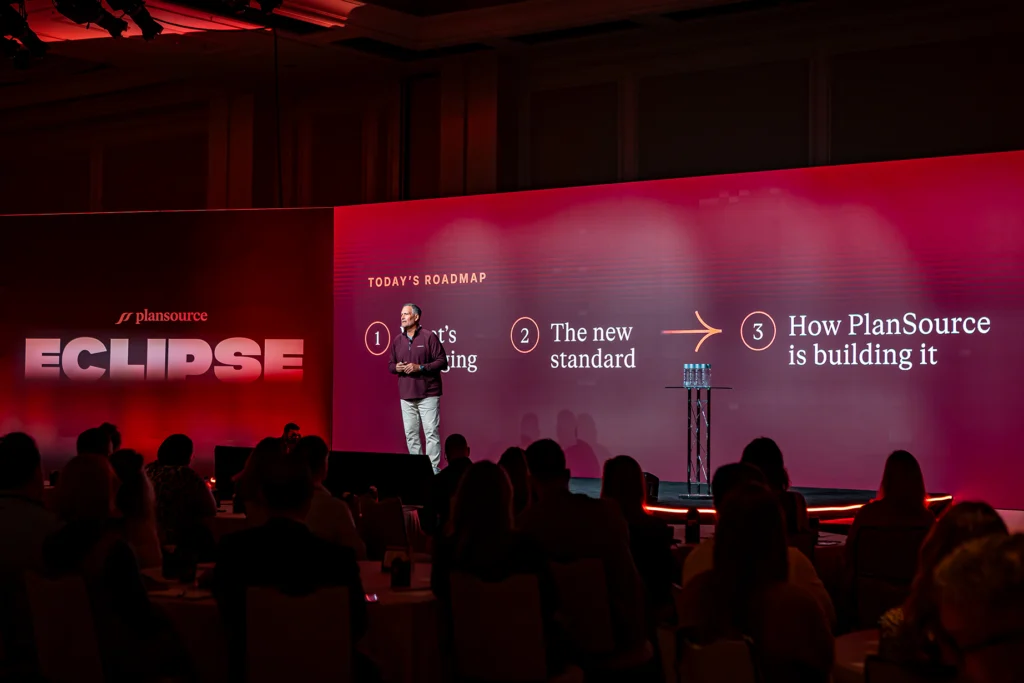
That framing set up the rest of the morning. Ana Perez, Chief Marketing Officer, and Greg Mercer, Chief Growth Officer, walked through three challenges they believe have defined this space for too long, and what each one means for benefits administration today.
“When someone is making a coverage decision, or navigating a family change, or dealing with a denied claim, they’re not just looking for speed. They’re looking for clarity, for confidence, and for a resolution they can trust.”
— Ana Perez, Chief Marketing Officer at PlanSource
Challenge one: Complexity has outpaced the systems built to manage it
HR teams routinely juggle anywhere from 15 to 50 different HR technologies and partners. “What looks like choice on paper is friction in reality,” Ana said. For consultants, that friction eats away at strategy time. For resellers, it ties their reputations to handoffs they don’t control. For employees, it means the system fails them at the worst possible moments, like the new parent who learns at the pharmacy counter that their newborn isn’t on the plan, or the employee navigating a denied claim alone.
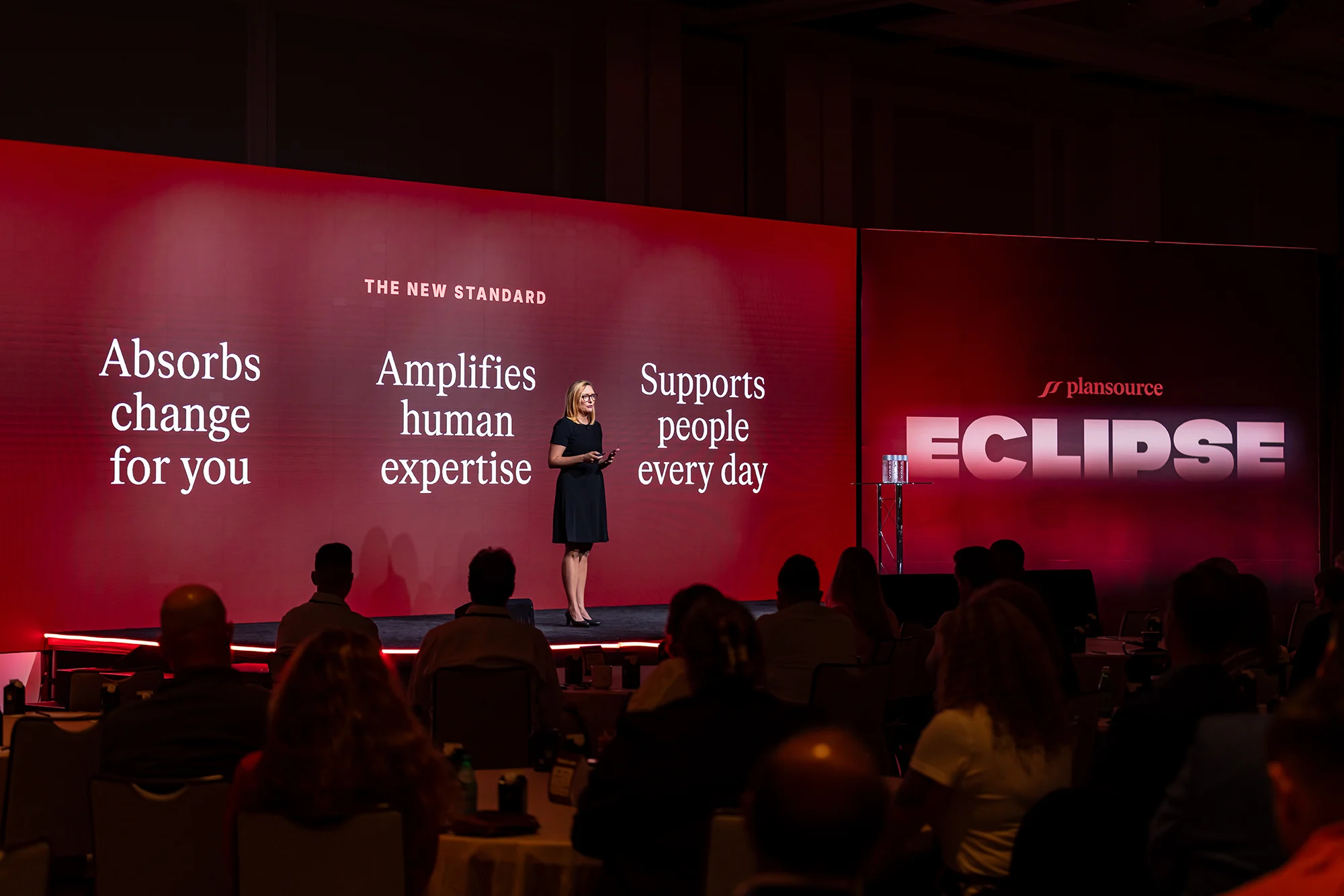
The new standard: a benefits administration platform that can absorb change and complexity instead of passing it back to HR.
Plan changes, eligibility updates, and implementations need to be simple to configure and reliable to deploy, with end-to-end data integrity owned by the system, not reconciled by exhausted humans. When something goes wrong, the platform should surface it before an employee feels it.
Challenge two: AI in a high-stakes space demands more than a chatbot
“When someone is making a coverage decision, or navigating a family change, or dealing with a denied claim, they’re not just looking for speed,” Ana said. “They’re looking for clarity, for confidence, and for a resolution they can trust.” Greg put the technical reality even more bluntly: “The hard part of AI and benefits is not building the future. You can literally build a chatbot while we’re in this session. The hard part is building trust into it.”
The new standard: AI that amplifies human expertise instead of replacing it.
AI and human expertise can no longer operate as separate layers that occasionally bump into each other. They have to function as one system. When a handoff happens between a virtual assistant and a live agent, the employee should not have to start over. When AI flags an exception, a human must own what comes next, and the chain of decisions must be auditable. Trust is built in the design, not bolted on afterward.
Challenge three: Cost and disengagement are eroding the value of every benefits strategy
Family medical coverage now averages close to $27,000. Over half of employees regret their annual benefits choices. Among Gen Z, that number climbs to 78 percent. “These employees aren’t disengaged because they don’t care,” Ana said. “They’re overwhelmed because the system isn’t helping them make confident decisions.” The same person who refinances a mortgage from their phone is being asked to navigate a 45-page benefits guide, call three different numbers to understand a claim, or wait days to learn whether a life event was approved.
The new standard: a benefits administration experience that supports people every day.
Benefits administration experiences cannot be designed around a single annual transaction. Open enrollment is one moment in a year that’s full of actions: the new diagnosis, the baby, the bill that doesn’t match the EOB at ten o’clock at night. Benefits administration has to evolve from a once-a-year transaction into a year-round relationship that meets people in those moments.
How PlanSource is meeting the new standard
Naming a new standard is one thing. Delivering it is another. The product, engineering, and service keynote showed how those three principles — absorbing complexity, fusing AI with human expertise, and showing up year-round — are being engineered into the platform itself.
A foundation built to power the new standard
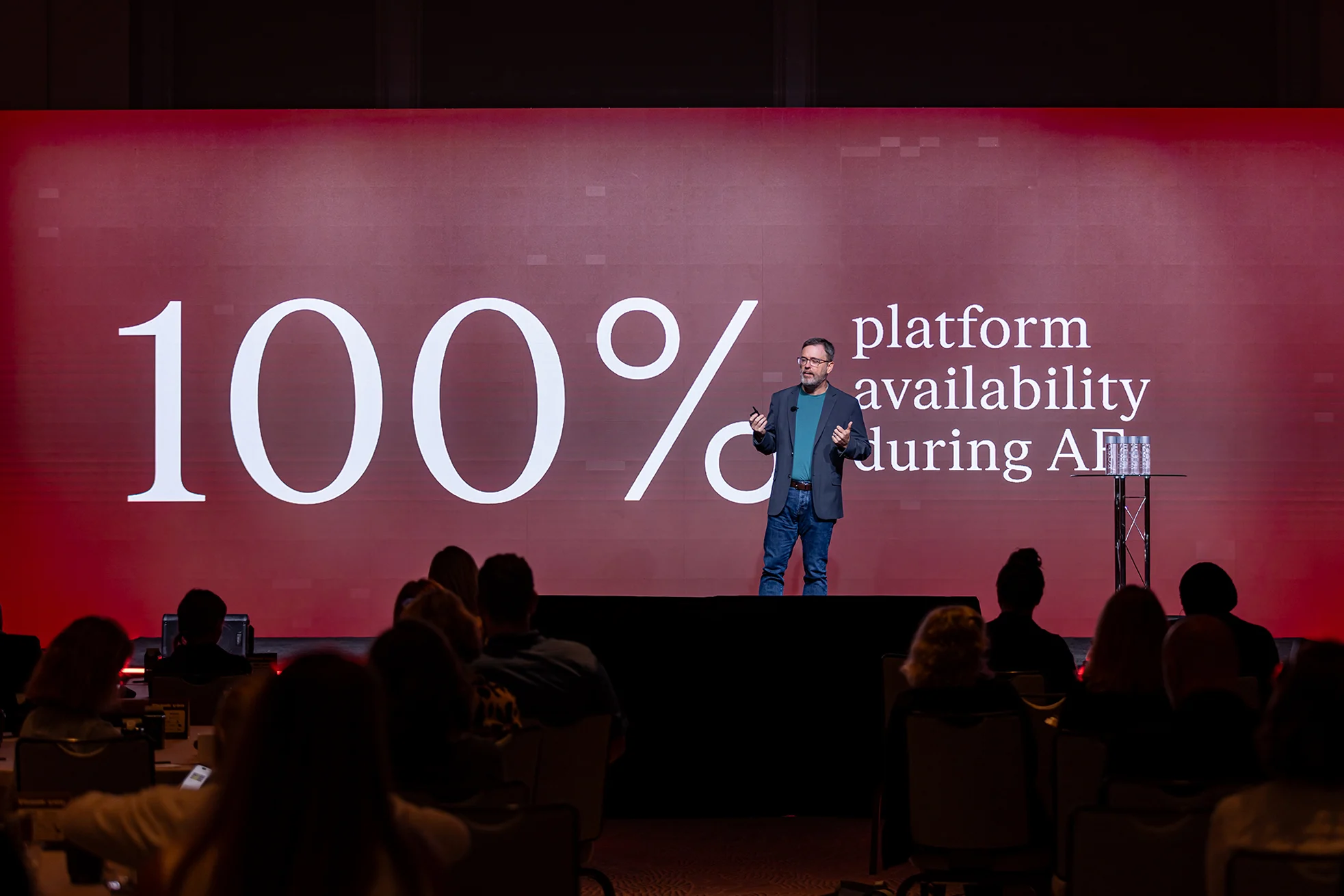
Mike Ehlers, Chief Technology Officer, grounded the conversation in numbers. During annual enrollment, when customers needed PlanSource most, the platform delivered 100 percent availability. Engineering throughput climbed 97 percent year over year. The team reclaimed 2,750 engineering hours every month, the equivalent of 17 additional engineers.
The old cadence of three big bang releases a year is giving way to weekly deployments, so enhancements reach customers smoothly the moment they are ready. How? By pointing AI at the parts of software development that drain engineers without adding value. PlanSource built a fleet of AI agents trained on its own code base to handle bug fixes around the clock and rolled out self-healing regression tests that can identify a broken test, analyze the cause, and propose a fix. The bigger shift is architectural.
PlanSource is building for an agentic AI world, where software talks to software through well-structured APIs and clean data contracts. “If your data model is inconsistent or your business rules aren’t exposed cleanly, the agent simply can’t do its job,” Mike said. The goal is a platform where agents can orchestrate workflows across enrollment, billing, compliance, and communications.
But this powerful foundation all of it sits on top of a non-negotiable principle. “Everything we do is observable, so you can see what happens. Auditable, so you can review every decision. And reversible.” The foundation gets faster, but humans remain in the driver’s seat.
A breakthrough for configuration & integration
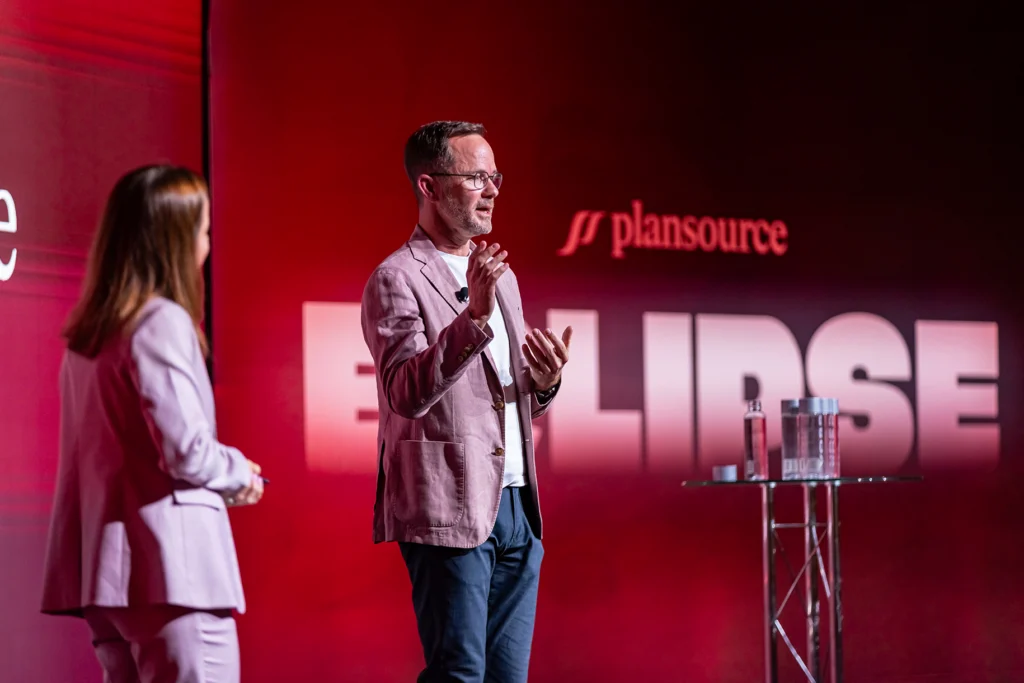
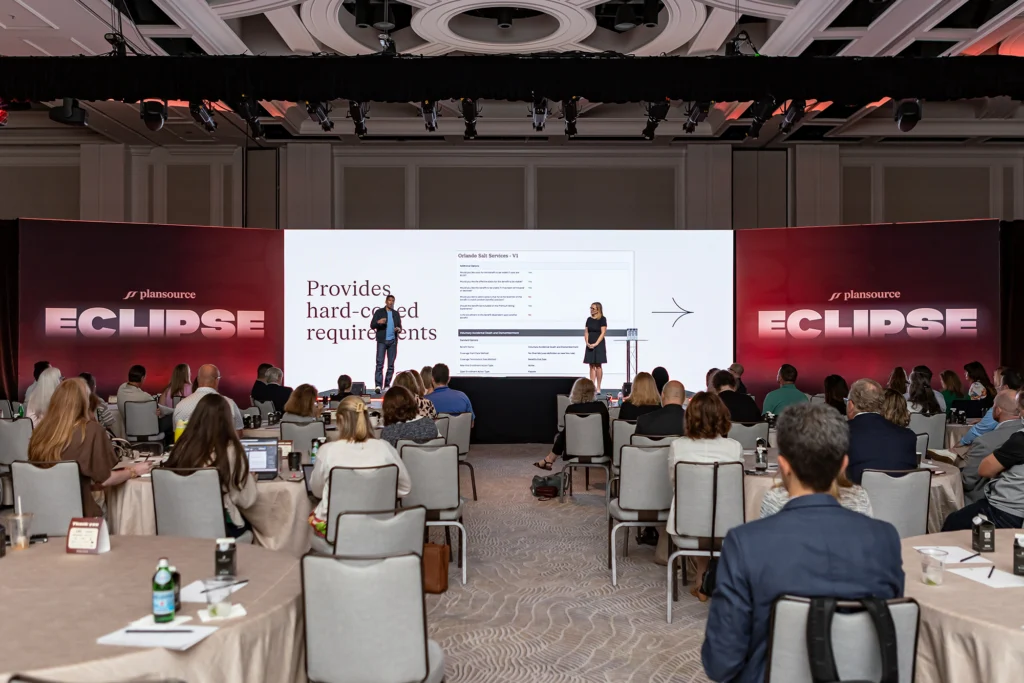
Eddie Pinto, Senior Vice President of Product, and Jenny Wear, Vice President of Product Marketing, walked customers through what that foundation makes possible.
Implementation and configuration, historically the most painful, manual, error-prone parts of benefits administration, are being rebuilt around new tooling that lets people managing configuration drag and drop rate sheets, SPDs, SBCs, population files, EDI templates, even messy lists of names, and more, and watch the AI pre-populate the configuration while flagging anything that needs human review. Paired with automated test suites powered by synthetic data that cover every permutation of valid values, (and even combinations that don’t yet exist) and requirements that are hard-coded in the system rather than reconciled later, the back-end of benefits administration starts to look fundamentally different.
Jenny grounded the work in what actually matters to the people doing it, and the people who depend on it. “Speed isn’t actually our goal in this whole thing,” she said. “Customers don’t want things done faster, necessarily. They want things done right so they can sleep at night. That’s what this makes possible more than ever before.”
A more personal, more proactive employee experience
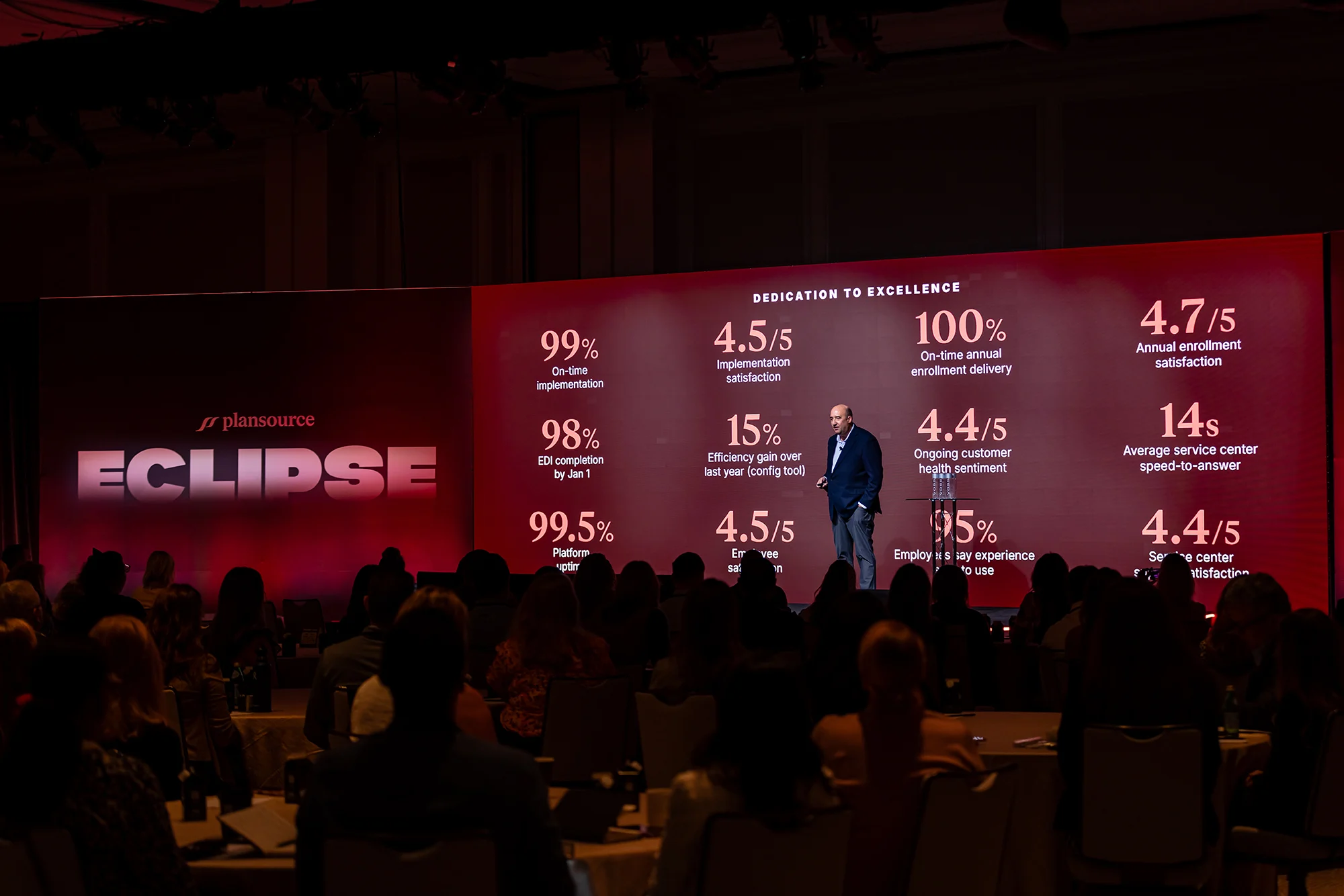
A year ago, PlanSource launched an entirely new enrollment experience grounded in behavioral psychology and consumer-grade design, with the goal of making it as simple to elect benefits as it is to buy a phone. Ninety-five percent of employees found it easy to use. “I’ve worked in this industry for two-plus decades,” Eddie said. “This is a career moment for me to say that 95 percent of people found the experience easy to use in benefits.”
That foundation is what makes the next step possible, continuing to build in ways that personalize the experience and support people every day and not just during enrollment.
“What if the benefits experience were so tailored to you as an individual, it acted as your trusted guide through each next step?”
— Jenny Wear, VP Product Marketing at PlanSource
One answer to that question is claims integration across the experience, from decision support to ongoing nudges that help employees use the coverage they have, including prompts about generic prescription alternatives, reminders to use a hospital indemnity plan they forgot they enrolled in, guidance toward preventative screenings, and more. Another answer is a fully retooled, agentic virtual assistant who not only converses and answers questions in someone’s native language, but can also take action, right from within Microsoft Teams.
A partnership with Health Advocate connects employees directly to clinicians and claims experts when a moment demands a real human. Each of these transactions, made effortless, is what earns the right to be the partner employees come back to in the moments that matter most.
Technology and service, at every point in time
Underneath every reimagined workflow or product enhancement is a quieter truth that ran through the day. Benefits administration is technology, but it is also service, and the human connection inside that service is what builds trust. That’s why our team was pleased to announce KESA, a knowledge engine super-agent that codifies institutional knowledge, best practices, SOPs, DOL regulations, ERISA compliance, and plan-document detail, and puts it inside Microsoft Teams at the fingertips of every operations team member. Now everyone supporting our customers, whether they’re a new hire or an industry veteran, has access to decades of expertise and consistent, high-quality information at their fingertips.
The proof shows up in metrics. In 2025, 100% of annual enrollments in PlanSource’s direct business were delivered on time with a customer satisfaction score of 4.7/5. The average speed to answer was 14 seconds across the entire service center, even during peak times. “Service that never settles isn’t just a tagline at PlanSource,” said Steve Parkhouse, SVP of Customer Success at PlanSource. “It’s the standard we hold ourselves to.”
Zooming out: how the industry is thinking about AI
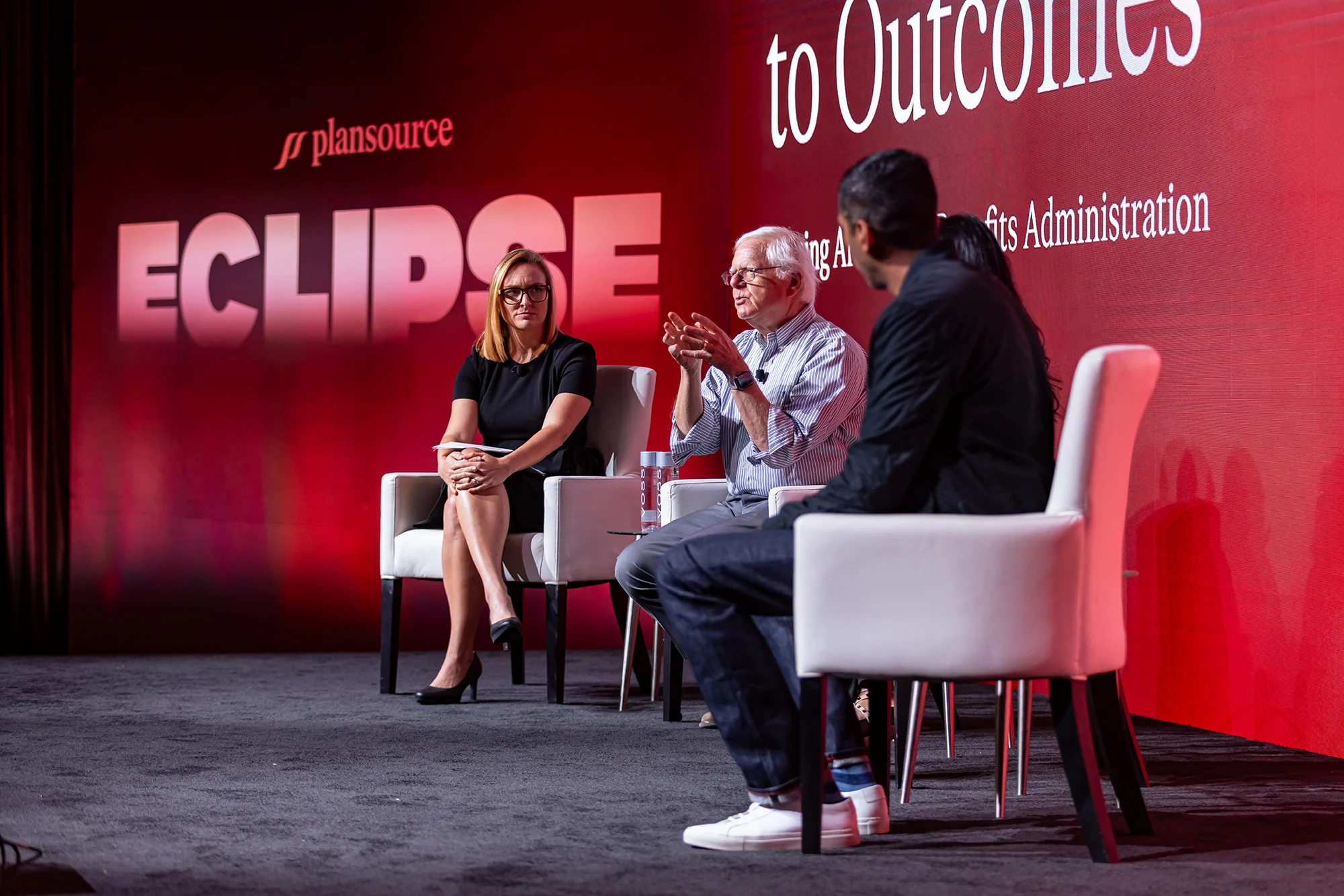
After lunch, the conversation broadened beyond what’s happening at PlanSource. Jenny Wear moderated a panel with Dr. Abbie Liebowitz, Chief Medical Officer and President Emeritus at Health Advocate; Dr. Urvashi Patel, MPH, SVP Commercial Analytics at Aon; and PlanSource’s own Eddie Pinto. The goal was to move past the theater of AI hype and look honestly at what’s working, what’s failing, and where the industry is headed.
Dr. Patel opened with research on how different populations actually perceive AI, and the gap between operators and users was striking. Sixty-one percent of consumers believe AI is accurate, compared to more than 90 percent of HR and health-plan leaders. Boomers and Gen X land around 40 to 50 percent confidence in AI accuracy; Millennials and Gen Z come in closer to 70 percent. “As you’re thinking about deploying some of these solutions, think about the population that you have,” she said. Her advice across the panel kept returning to one theme: build solutions not for people, but with them.
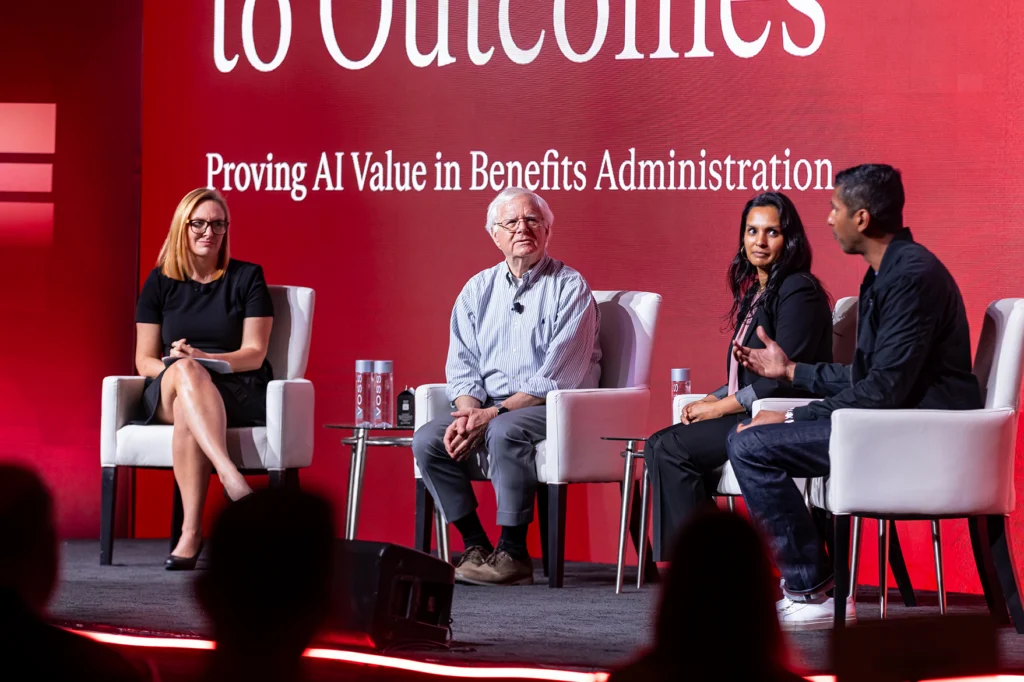
Dr. Liebowitz brought the physician’s perspective and was candid about the dichotomy companies face around AI and data privacy. Many of Health Advocate’s large enterprise clients are deeply protective of their data even as employees inside those same companies use public AI tools every day. The path forward, in his view, is a combination of better tooling, clearer governance, and the patience to let comfort catch up with capability.
When the conversation turned to what separates the successful AI pilots from the failed ones, Eddie offered a distinction that landed with the room. Most failures fall into two camps. The first is the scattershot pilot, where an executive asks for more AI without a clear problem to solve. The second is more dangerous because it can look like success: optimization AI aimed purely at cutting costs or headcount. But the companies that win, he said, are the ones who figure out how to accelerate their roadmap, using AI to do things that weren’t possible before, accelerating, not contracting.
Dr. Liebowitz and Dr. Patel picked up the thread, emphasizing that AI changes the way work happens, for example spending less time wrangling code and more time generating insights that actually help clients and teams make better decisions.
What it all comes back to
Jenny closed the panel with a line that could stand in for the entire conference. “What matters most, ultimately, in this business and all others, is the human connection. Nothing replaces the need for human connection and human intelligence, and that’s what makes people really powerful.”
That is the standard PlanSource committed to, in front of customers and partners, over two days. Absorb complexity instead of passing it back. Fuse AI and human expertise into one continuous experience. Stay present in the everyday health and benefits journey, not just during open enrollment.
As Mike Morini put it near the end of his keynote, “We understand it’s one thing to talk about the future. It’s another thing for us to build it together.” Eclipse 2026 was the conference where PlanSource asked the industry to hold it to that promise, and where the ecosystem showed up to build it alongside us.